At a glance
- Client / partner
- Travly
- Industry
- Travel Tech
- Services offered
- Dedicated Engineering Pod
- Web & Mobile Development
- Cloud Architecture
- AI / LLM Integration
- Tech stack used
- React Native
- Node.js
- Edge caching
- Event streaming
- LLM orchestration
- Tokenized payments
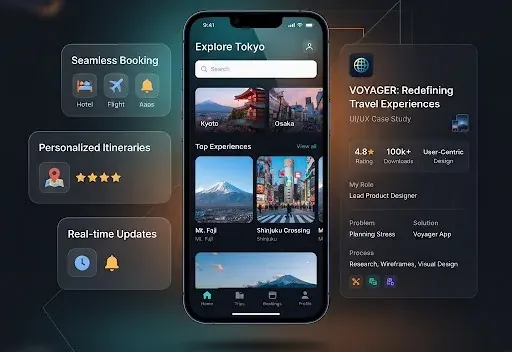
Travly is a travel booking platform that brings search, booking and in-trip support into one app.
Travly brought in a Zemotify pod to build its cross-platform booking engine, real-time itinerary intelligence and hotel inventory synchronization, alongside a conversational AI concierge.
Introduction
Travel booking is a race against stale data. Prices, room availability and itineraries change by the minute, and every supplier exposes them differently. A traveller who sees a price at search and a different one at checkout rarely comes back.
Travly wanted one experience across web and mobile that felt instant: search that answers in real time, an itinerary that updates itself when plans change, and a concierge that can answer “what now?” without a support queue.
They needed an engineering pod that could own the booking core end to end, from supplier integrations to checkout, while their in-house team focused on product and growth.
The challenges
The hard part was never the interface. It was keeping fast-moving data honest across many sources:
-
Many suppliers, one search
Hotel and travel inventory arrives from multiple supplier APIs, each with its own formats, rate limits and failure modes, yet results have to appear as one consistent list.
-
Availability that changes mid-session
Rooms and fares can sell out between search and payment. The platform had to detect changes early and explain them clearly instead of failing at checkout.
-
Speed across regions
Travellers search from everywhere. Response times had to stay consistent globally, not just close to the main data centre.
-
An AI concierge that stays grounded
A conversational assistant is only useful if its answers match live bookings and real availability, never invented options.
-
Checkout without friction
Every extra step at payment costs bookings. Checkout needed to be short, secure and consistent on web, iOS and Android.
-
Payments and personal data
Card details, passports and itineraries are sensitive. Security and compliance had to be designed in, not bolted on.
The approach
We built a booking core that absorbs supplier complexity on the server, so the traveller only ever sees one fast, consistent product:
A unified inventory layer
Supplier adapters normalise every source into one canonical model for hotels, rooms, rates and policies, with retries and circuit breakers so one slow supplier never stalls a search.
Edge-synchronised search
Frequently requested inventory is cached close to travellers and refreshed by events, so search stays fast while prices are re-confirmed before anything is charged.
Real-time itinerary intelligence
Bookings, schedule changes and supplier updates flow through one event stream, so the itinerary updates itself and travellers are told about changes before they find out the hard way.
One-tap tokenised checkout
Saved, tokenised payment methods and a single confirmation step on every platform, with price re-validation built into the same transaction.
The systems behind every booking
How the booking engine keeps many moving sources in step for one traveller.
-
Supplier Adapters
Each supplier behind its own resilient adapter with a shared contract.
-
Canonical Inventory
One model for hotels, rooms, rates and policies across every source.
-
Edge Search Cache
Popular queries answered close to the traveller, refreshed by events.
-
Itinerary Event Stream
Bookings and supplier changes processed once and pushed everywhere.
-
AI Concierge
Answers grounded in the traveller’s live bookings, with hand-off to a human.
-
Secure Checkout
Tokenised payments and price re-validation in a single step.
An AI concierge with guardrails
The assistant reads the traveller’s itinerary and live availability through the same APIs the app uses, and hands over to a person whenever it can’t answer with confidence.
Observability from day one
Tracing across supplier calls, search and checkout made slow suppliers and failed bookings visible to the team before travellers had to report them.
A delivery rhythm the client could see
Fortnightly releases, weekly demos and a shared roadmap kept Travly’s product team in control of priorities.
The outcome
Headline figures below come from the project brief; everything else is described qualitatively:
One booking experience: search, booking and itinerary management delivered across web and mobile from a single core.
Faster search: globally distributed inventory responses, reported in the brief at under 140ms P99.
Fewer abandoned checkouts: a shorter, tokenised payment flow, with the brief reporting a 4.2x lift in funnel completion.
Room to grow: new suppliers plug into the adapter layer without changes to the app.
- 4.2x
Funnel completion with 1-click checkout (project brief)
- <140ms
Global P99 search response (project brief)
- +185%
Team velocity vs. prior roadmap (project brief)
Technology used
An illustrative view of the toolchain used for this kind of build (to be confirmed with the project team):
| Mobile & Web | React Native, TypeScript, Next.js |
|---|---|
| Booking Core | Node.js services, PostgreSQL, Redis |
| Search & Caching | Edge caching, event-driven cache refresh |
| Events | Message streaming for bookings and supplier updates |
| AI Concierge | LLM orchestration with retrieval over live itinerary data |
| Payments | Tokenised card vault, PCI-scoped payment provider |
| Observability | Distributed tracing, error monitoring, uptime alerting |